Deer in Upstate SC can cause serious road hazards. Learn what to do after a collision, including safety, liability, insurance, and reporting steps.
Few drivers expect to collide with a deer until it suddenly happens. In the Upstate, the risk is especially worth considering as fall approaches, when deer become more active and daylight hours get shorter.
If you do hit a deer, the priority is getting yourself and anyone else out of danger before you think about who’s at fault or calling your insurance company.
What to Do Immediately After Hitting a Deer
In the event of a deer-vehicle collision, remaining calm and taking the appropriate steps is essential:
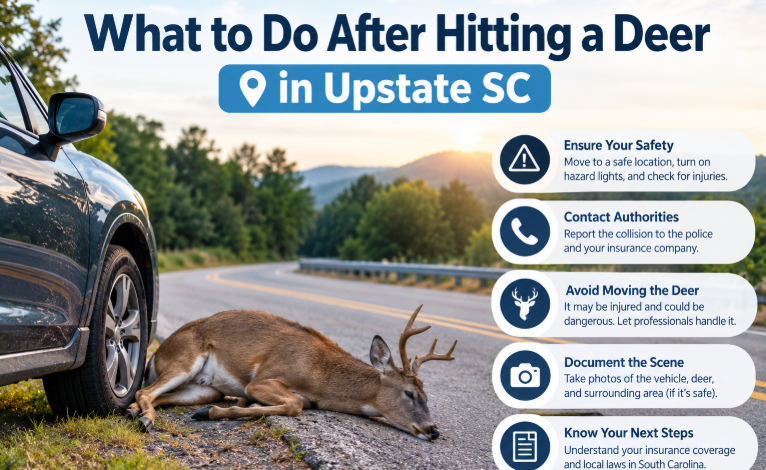
- If you can still drive your vehicle, pull as far off the road as you safely can and turn on your hazard lights. If you can’t move your vehicle, make sure you’re safe and visible to other drivers.
- Check yourself and your passengers for injuries. A collision that appears to be a relatively minor fender-bender can still cause injuries, particularly if the vehicle leaves the road or another vehicle is involved.
- Once you’re somewhere safe, report the incident. The South Carolina Department of Natural Resources (SCDNR) advises motorists who hit a deer to report the incident to the South Carolina Highway Patrol or local law enforcement.
- You should also contact law enforcement if anyone is injured, your vehicle is creating a hazard, another vehicle was involved, or the circumstances of the crash may later be disputed. South Carolina law requires an immediate report when a vehicle accident results in injury or death.
- Document what happened by taking photographs of the vehicle, the road, the surrounding area, and the damage. Make a note of the approximate time, location, direction of travel, and anything you remember about what happened immediately before the collision.
Don’t approach an injured deer or stand in the roadway trying to move it. Let law enforcement or the appropriate road authority deal with the animal.
Who Is Liable for a Deer Collision?
A straightforward deer strike is different from a crash caused by another driver. If you are traveling normally and your vehicle hits a deer, there usually isn’t another negligent driver to pursue for the damage, and your own insurance coverage becomes important.
In South Carolina, comprehensive coverage generally covers damage to a vehicle caused by hitting an animal. In contrast, collision coverage applies to damage caused when your vehicle collides with an object such as another vehicle or a tree. Both are optional coverages.
The exact outcome depends on the policy, deductible, and circumstances, so it’s worth checking your coverage rather than assuming a deer strike is automatically covered.
When an attempt to avoid a deer results in striking a tree, a guardrail, or another vehicle, assessing fault and legal responsibility can be more complicated than in a direct animal collision. If multiple vehicles, severe injuries, or disputed claims are involved, determining whether another driver shares fault becomes a focus.
Why Deer Collisions Increase in the Fall
South Carolina sees increased deer movement during the fall rut, or breeding season. SCDNR says the rut typically runs from October through November, with the last two weeks of October through the first two weeks of November generally considered the peak period. Around 45% of deer-vehicle collisions occur during the rut.
Deer are also particularly active around dawn and dusk, when many people are commuting. Rural and secondary roads can present additional risks because of curves, narrow shoulders, and surrounding woodland.
You can’t always avoid a deer, but you can reduce the risk by:
- Slowing down when traveling through areas with deer-crossing signs
- Paying particular attention around dawn and dusk
- Watching the edges of the road rather than focusing only on the lane immediately ahead.
If you see one deer cross the road, don’t immediately assume the danger has passed. Deer often travel in groups, so another may follow.
And if a collision becomes unavoidable, SCDNR advises against making a sudden evasive maneuver that could cause you to lose control of the vehicle.
When Is It Worth Speaking to an Attorney?
A single deer strike involving vehicle damage but no injuries may simply be an insurance matter. However, it’s different if you were injured, another vehicle was involved, you swerved to avoid the deer and crashed, or the insurance company is disputing what happened.
In those situations, it can be useful to speak with a car accident lawyer. The same applies if you’re unsure whether your injuries came from the initial deer impact, a secondary collision, or both.
The key is not to assume every deer accident is either a simple insurance claim or automatically a personal injury case. The circumstances of the collision, the available insurance coverage, and whether anyone else may be legally responsible all matter.
If you’ve been involved in a deer-related crash in the Upstate, The Clardy Law Firm can help you understand what options may be available based on the specific circumstances of the accident.